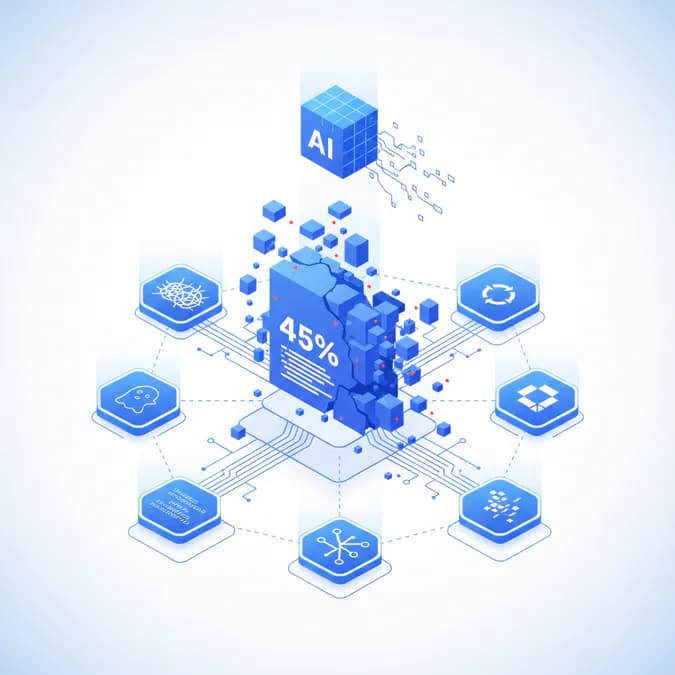
AI-generated code security has emerged as a critical concern for development teams worldwide. AI code generation promises to revolutionize developer productivity, but security research paints a troubling picture. Independent security firms have tested over 150 AI models and found that 45% of AI-generated code fails basic OWASP security checks. This comprehensive analysis reveals six predictable vulnerabilities that appear in nearly every AI-coded application—and most can be identified within 30 minutes of testing.
The rise of AI coding assistants like GitHub Copilot and ChatGPT has transformed how developers write code. These large language models (LLMs) promise to automate routine coding tasks and accelerate development cycles. However, the security implications are severe. Studies show that 62% of AI-generated code solutions contain design flaws or known vulnerabilities, creating significant risks for organizations deploying these tools without proper security oversight. Understanding AI-generated code security risks is now essential for any development organization.
The AI Code Generation Security Crisis
The statistics surrounding AI-generated code security are alarming. According to Veracode's comprehensive analysis of 100+ LLMs across 80 coding tasks, 45% of AI-generated code introduces security flaws. The
 ecurityalliance.org/blog/2025/07/09/understanding-security-risks-in-ai-generated-code" target="_blank" rel="noopener">Cloud Security Alliance Study pushes this figure even higher, reporting that 62% of AI-generated code solutions contain design flaws or known vulnerabilities. These aren't theoretical risks—they're practical security failures that expose organizations to real-world attacks.
The problem stems from fundamental issues in how AI models are trained and optimized. AI coding assistants are trained on vast public repositories that contain insecure code patterns. When developers commit vulnerable code to GitHub or other public platforms, these patterns become part of the training data. The models then replicate these insecure patterns in their outputs, creating a feedback loop that perpetuates security flaws across thousands of generated applications.
Moreover, AI models optimize for functionality and syntax correctness rather than security. A piece of code might run perfectly and produce the correct output while containing critical vulnerabilities. The models lack understanding of application-specific risk models, internal security standards, and threat landscapes. As the Cloud Security Alliance notes, "AI coding assistants don't inherently understand your application's risk model, internal standards, or threat landscape."
Understanding the Testing Methodology
The independent security research that revealed these vulnerabilities employed rigorous testing methodologies. Researchers tested 150+ AI models using standardized security assessment frameworks, primarily focusing on OWASP compliance checks. These tests evaluated code generated across multiple programming languages and use cases.
The testing process involved submitting identical coding tasks to different AI models and analyzing the generated code for security vulnerabilities. Researchers used automated scanning tools and manual code review to identify issues. The focus was on common vulnerability types mapped to the Common Weakness Enumeration (CWE) system, which provides a standardized way to classify software weaknesses.
One particularly comprehensive analysis examined over 4,241 CWE instances identified in GitHub AI-generated code via CodeQL analysis. This large-scale assessment provided empirical evidence of the scope and severity of vulnerabilities in production AI-generated code. The breadth of this analysis demonstrates that the security problems aren't isolated to specific models or use cases—they're systemic across the AI code generation landscape.
The Six Predictable Vulnerabilities in AI-Generated Code Security
Research consistently identifies six predictable vulnerabilities that appear in nearly every AI-generated application. Understanding these vulnerabilities is critical for developers and security teams implementing AI code generation tools. These patterns represent the most common failure points in AI-generated code security assessments.
1. Cross-Site Scripting (CWE-79/80)
AI models fail Cross-Site Scripting checks 86% of the time due to poor sanitization understanding. The models often generate code that doesn't properly validate or escape user input before rendering it in web contexts. This is one of the most critical vulnerabilities in web applications, allowing attackers to inject malicious scripts into web pages viewed by other users. The generated code frequently lacks proper output encoding and input validation mechanisms that are essential for preventing XSS attacks.
2. SQL Injection (CWE-89)
AI models frequently generate code that concatenates user input directly into SQL queries rather than using parameterized queries or prepared statements. This classic vulnerability allows attackers to manipulate database queries and access or modify sensitive data. The models replicate insecure patterns from training data that contain string-concatenated SQL queries, perpetuating a vulnerability pattern that has been well-understood for decades.
3. Cryptographic Failures (CWE-327)
AI-generated code often implements weak or broken cryptographic algorithms, uses hardcoded encryption keys, or fails to properly implement encryption for sensitive data. The models may suggest outdated cryptographic methods or implement encryption incorrectly, leaving sensitive information vulnerable to compromise. This is particularly concerning for applications handling payment information, personal data, or other sensitive information.
4. Log Injection (CWE-117)
AI models frequently generate code that doesn't properly sanitize user input before logging it. Attackers can inject newline characters and other special characters into logs, corrupting log files and potentially hiding their malicious activities. This vulnerability undermines the ability to detect and investigate security incidents.
5. Insecure Dependency Management
AI models often hallucinate non-existent dependencies or suggest outdated packages with known vulnerabilities. This creates supply chain risks and enables attacks like slopsquatting, where attackers register package names similar to legitimate ones to distribute malicious code. The models may generate code that references packages that don't exist, causing build failures or leading developers to install malicious packages with similar names.
6. Prompt Injection (LLM01)
As highlighted by OWASP, prompt injection vulnerabilities allow attackers to manipulate AI models through crafted inputs, potentially causing the models to generate malicious code or reveal sensitive information. This emerging vulnerability class is specific to AI systems and represents a new attack vector that developers must understand.
Why AI Models Fail Security Checks
The root causes of these vulnerabilities are multifaceted. Training data contamination is a primary factor. AI models learn from publicly available code repositories that contain insecure patterns. When developers commit vulnerable code to GitHub or similar platforms, these patterns become part of the training dataset. The models then replicate these patterns in their outputs, perpetuating security flaws at scale.
Language-specific vulnerabilities also play a role. Research shows that Python AI-generated code exhibits vulnerability rates of 16-18%, significantly higher than JavaScript at 8-9%. Different programming languages have different security characteristics and common pitfalls, and AI models may not adequately account for these differences. This suggests that the models have learned language-specific insecure patterns from their training data.
The lack of application context is another critical issue. AI models generate code in isolation, without understanding the broader application architecture, security requirements, or threat model. They don't know what data is sensitive, what compliance requirements apply, or what security controls are already in place. This contextual blindness leads to generic code that may not align with security best practices for specific applications.
Importantly, newer and larger models don't necessarily generate more secure code. According to the Veracode Research Team, "Newer and larger models don't generate significantly more secure code than their predecessors." Despite improvements in syntax and code quality, security performance has stagnated. This suggests that simply scaling up models or improving their general capabilities won't solve the security problem—specialized approaches are needed.
Identifying AI-Generated Code Security Issues in 30 Minutes
The good news is that most AI-generated code security vulnerabilities can be identified quickly using automated scanning tools and focused manual review. Security teams can assess AI-generated code for the six predictable vulnerabilities in approximately 30 minutes using a structured approach.
Automated scanning tools like CodeQL, Semgrep, and commercial SAST (Static Application Security Testing) solutions can identify many of these vulnerabilities automatically. These tools scan code for known vulnerability patterns and CWE instances, providing detailed reports of findings.
A practical 30-minute assessment process for AI-generated code security might include:
- Run automated SAST tools configured for OWASP Top 10 vulnerabilities (5 minutes)
- Review generated code for SQL injection patterns and database query construction (5 minutes)
- Examine input validation and output encoding for XSS prevention (5 minutes)
- Check cryptographic implementations and key management (5 minutes)
- Verify dependency declarations and check for known vulnerabilities (5 minutes)
- Document findings and prioritize remediation (5 minutes)
This rapid assessment approach allows security teams to quickly identify the most critical issues and prioritize remediation efforts. However, this should be considered a baseline assessment—comprehensive security reviews may require more time and deeper analysis. The key advantage is that organizations can quickly identify whether AI-generated code meets minimum security standards before deployment.
Real-World Impact and CVE Data
The security risks of AI-generated code are no longer theoretical. In March 2026, researchers reported at least 35 new CVEs directly linked to AI-generated code. This represents a significant shift from academic concerns to real-world exploitation. These CVEs demonstrate that vulnerabilities in AI-generated code are being discovered and exploited in production environments.
The emergence of CVEs from AI-generated code signals that organizations are deploying AI-assisted code at scale without adequate security controls. As more developers use AI coding assistants, the attack surface expands. Attackers can identify common vulnerability patterns in AI-generated code and develop exploits that work across multiple applications—a technique researchers call "AI-fingerprinting."
This creates a supply chain risk where a single vulnerability pattern in AI-generated code could affect thousands of applications simultaneously. The homogeneous nature of AI-generated code—where many applications contain similar vulnerable patterns—amplifies the impact of any discovered vulnerability. Unlike traditional software vulnerabilities that might affect a specific product or service, AI-generated vulnerabilities can propagate across diverse applications and organizations.
Best Practices for Secure AI Code Generation
Organizations using AI coding assistants should implement comprehensive security practices to mitigate risks. These practices address the core challenges in AI-generated code security and establish a foundation for safe AI-assisted development.
Human Review and Oversight
Never deploy AI-generated code without human review. Security-trained developers should review all AI-generated code before it enters production, paying special attention to the six predictable vulnerabilities. This human element is critical because AI models can't understand application-specific security requirements. Industry experts emphasize that human oversight remains the most reliable control for ensuring AI-generated code security.
Secure Prompting Techniques
Craft prompts that explicitly request secure code. Include security requirements in prompts, such as "Generate SQL code using parameterized queries" or "Implement input validation for all user inputs." Research shows that security-focused prompts can improve the security of generated code, though they don't eliminate vulnerabilities entirely. This approach helps guide AI models toward more secure patterns.
Specialized Scanning Tools
Use SAST tools specifically configured to detect vulnerabilities in AI-generated code. Tools like CodeQL and Semgrep can be customized with rules targeting common AI-generated vulnerability patterns. Organizations should invest in tools that understand the specific vulnerability patterns that AI models produce.
Security Training
Ensure developers understand the security implications of AI-generated code. Training should cover the six predictable vulnerabilities and how to identify and remediate them. Developers need to understand that AI-generated code requires the same security scrutiny as any other code.
Policy and Governance
Establish organizational policies governing AI code generation. Define which coding tasks are appropriate for AI assistance and which require human development. Implement code review processes that specifically address AI-generated code. Organizations should treat AI code generation as a tool that requires governance, not as a replacement for security practices.
Dependency Management
Implement strict dependency management practices. Verify that all dependencies exist and are legitimate, and regularly scan dependencies for known vulnerabilities. Given that AI models hallucinate dependencies, this practice is essential for preventing supply chain attacks.
Testing and Validation
Conduct security testing on applications that include AI-generated code. Include security test cases in your testing strategy to validate that the code meets security requirements. Security testing should be as rigorous for AI-generated code as for any other code.
Key Takeaways
- 45% of AI-generated code fails basic OWASP security checks, indicating widespread security risks in AI-assisted development
- Six predictable vulnerabilities appear consistently in AI-generated code: XSS, SQL injection, cryptographic failures, log injection, insecure dependencies, and prompt injection
- AI models optimize for functionality, not security, replicating insecure patterns from training data without understanding application-specific risks
- Security vulnerabilities can be identified in 30 minutes using automated SAST tools and focused manual review of common vulnerability patterns
- Human oversight is essential—AI-generated code should never be deployed to production without security review by trained developers
- Real-world CVEs linked to AI-generated code demonstrate that these vulnerabilities are actively exploited in production environments
- Secure prompting, specialized scanning, and organizational policies are critical controls for managing AI-generated code security risks
Frequently Asked Questions About AI-Generated Code Security
What percentage of AI-generated code fails security checks?
According to independent security research, 45% of AI-generated code fails basic OWASP security checks. Some studies report even higher failure rates for specific vulnerability types, such as 86% failure rate for Cross-Site Scripting (XSS) checks.
Which vulnerabilities are most common in AI-generated code?
The six most predictable vulnerabilities in AI-generated code are: Cross-Site Scripting (CWE-79/80), SQL Injection (CWE-89), Cryptographic Failures (CWE-327), Log Injection (CWE-117), Insecure Dependency Management, and Prompt Injection (LLM01). These vulnerabilities appear consistently across different AI models and coding tasks.
How long does it take to identify vulnerabilities in AI-generated code?
Most AI-generated code vulnerabilities can be identified within 30 minutes using a structured assessment approach. This involves running automated SAST tools (5 minutes), reviewing code for specific vulnerability patterns (15 minutes), and documenting findings (5 minutes). However, comprehensive security reviews may require additional time.
Why do AI models generate insecure code?
AI models generate insecure code because they are trained on public code repositories that contain vulnerable patterns. The models optimize for functionality and syntax correctness rather than security, and they lack understanding of application-specific security requirements and threat models. This creates a feedback loop where insecure patterns are perpetuated across generated code.
Can larger AI models generate more secure code?
Research indicates that newer and larger AI models do not necessarily generate significantly more secure code than their predecessors. Despite improvements in general code quality and syntax, security performance has remained relatively stagnant. This suggests that model size alone is not sufficient to address security vulnerabilities.
What is the best way to secure AI-generated code?
The most effective approach combines multiple controls: human security review, secure prompting techniques, specialized SAST scanning tools, developer security training, organizational policies, strict dependency management, and comprehensive security testing. No single control is sufficient—a layered approach is necessary.
Are there real-world examples of AI-generated code vulnerabilities being exploited?
Yes. In March 2026, researchers reported at least 35 new CVEs directly linked to AI-generated code. This demonstrates that vulnerabilities in AI-generated code are being discovered and actively exploited in production environments, making security controls essential.
Should organizations stop using AI code generation tools?
No. AI code generation tools offer significant productivity benefits when used responsibly. The key is to treat AI-generated code as a starting point that requires security review and hardening, not as production-ready code. With proper security controls and oversight, organizations can harness the benefits of AI code generation while managing risks.
The Path Forward
AI code generation is here to stay, and its adoption will only increase. However, the security risks are real and measurable. The 45% failure rate on basic OWASP checks, the 86% failure rate on XSS checks, and the emergence of CVEs from AI-generated code all point to a critical need for better AI-generated code security practices.
The solution isn't to abandon AI coding assistants but to use them responsibly. Organizations should treat AI-generated code as a starting point that requires security review and hardening, not as production-ready code. By implementing the practices outlined above and maintaining human oversight, organizations can harness the productivity benefits of AI code generation while managing security risks.
Research from Veracode, the Cloud Security Alliance, and CSET Georgetown provides clear guidance: AI models won't solve the security problem on their own. Security must be built into the development process through human review, secure prompting, specialized scanning, and organizational policies. The 30-minute assessment window for identifying vulnerabilities provides a practical starting point for organizations looking to secure their AI-generated code.
As the cybersecurity landscape evolves, staying informed about AI code generation risks and implementing best practices will be essential for protecting applications and data. The convergence of AI adoption and security risks demands immediate attention from development teams and security professionals alike. By prioritizing AI-generated code security, organizations can confidently leverage AI tools while maintaining robust protection against emerging threats.
Sources
- Automated Pipeline
- AI-Generated Code Security Risks: What Developers Must Know
- Understanding Security Risks in AI-Generated Code | CSA
- Cybersecurity Risks of AI-Generated Code - CSET
- [2510.26103] Security Vulnerabilities in AI-Generated Code - arXiv
- Researchers Sound the Alarm on Vulnerabilities in AI-Generated Code
- Source: augmentcode.com
- Source: radware.com
- Source: apiiro.com
- Source: endorlabs.com