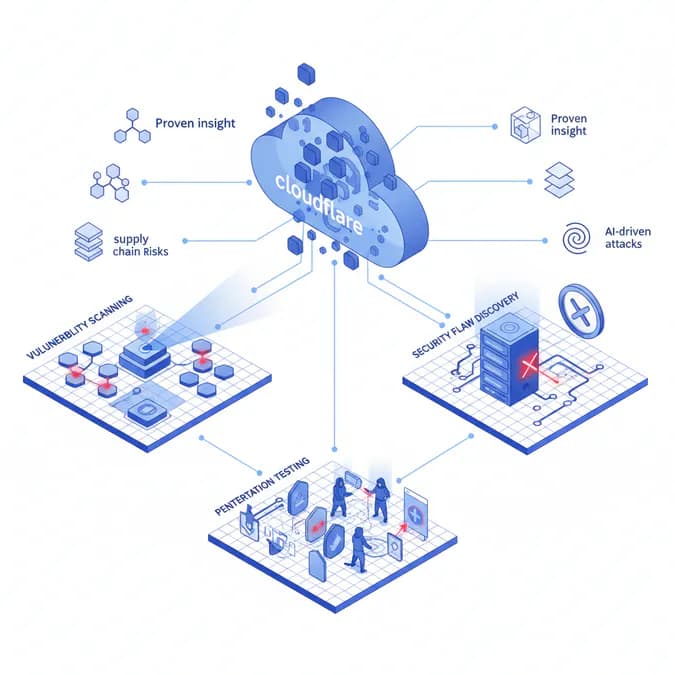
The cybersecurity landscape is constantly evolving, and staying ahead of emerging threats is crucial for organizations of all sizes. Cloudflare's recently released 2026 Threat Report sheds light on the latest trends and tactics used by cybercriminals, revealing a significant shift towards industrialized cyber threats. This report highlights a record-breaking 31.4 Tbps DDoS attack and sophisticated techniques that demand a proactive approach to security. Let's delve into the key findings of the report and explore what they mean for your organization.
Introduction: The 2026 Threat Landscape
The Cloudflare 2026 Threat Report, released on March 3, 2026, paints a stark picture of the current cybersecurity environment. The report identifies a fundamental shift towards industrialized cyber threats, characterized by increased automation, scale, and sophistication. This evolut

Industrialization of Cyber Threats
One of the most significant takeaways from the Cloudflare 2026 Threat Report is the increasing industrialization of cybercrime. This trend is driven by the desire for efficiency and return on investment (ROI) among cybercriminals. The report highlights several factors contributing to this industrialization:
- Automation: Attackers are leveraging generative AI and large language models to automate tasks such as exploit development and phishing campaign creation.
- Credential Reuse: A staggering 63% of all login attempts involve credentials already compromised elsewhere, indicating widespread credential reuse and the effectiveness of identity-based attack vectors [Source: Cloudflare 2026 Threat Report].
- Bot-Driven Attacks: The report reveals that 94% of login attempts now originate from automated bots rather than legitimate users, reflecting the industrialization of attack operations [Source: Cloudflare 2026 Threat Report].
According to the Cloudflare Threat Research Team, "We are witnessing the industrialization of cybercrime, where attack efficiency and ROI are the primary drivers" [Softprom].
Record DDoS Attack Analysis
Distributed Denial-of-Service (DDoS) attacks continue to be a major threat, and the Cloudflare 2026 Threat Report documents a significant escalation in their scale and frequency. In 2025, Cloudflare observed 47.1 million DDoS attacks, more than double the figure from 2024 [Source: Cloudflare 2026 Threat Report]. The report also highlights a record-breaking 31.4 Tbps UDP flood attack launched by the Aisuru botnet in November 2025 [Source: Cloudflare 2026 Threat Report]. This attack was nearly six times larger than the previous year's peak, demonstrating the exponential growth in attack scale.
Key statistics related to DDoS attacks include:
- 31.4 Tbps UDP flood attack: Record-breaking DDoS attack launched by Aisuru botnet in November 2025 [Source: Cloudflare 2026 Threat Report]
- 19 new world-record DDoS attacks in 2025: Number of unprecedented attack records documented by Cloudforce One during the year [Source: Cloudflare 2026 Threat Report]
- Network-layer attacks tripled year-over-year: Growth rate of network-layer DDoS attacks comparing 2025 to 2024 [Source: Cloudflare 2026 Threat Report]
Sophisticated Attack Methodologies
Beyond the sheer scale of attacks, the Cloudflare 2026 Threat Report also sheds light on the increasingly sophisticated methodologies employed by cybercriminals. These include:
- Living off the XaaS (LotX): Threat actors are increasingly routing malicious activity through legitimate cloud services like AWS, Google Cloud, Azure, and SaaS platforms like Google Calendar and Dropbox to blend attack traffic with normal enterprise usage and evade detection.
- AI-Generated Deepfakes: North Korean operatives are using AI-generated deepfakes and fraudulent identification to bypass corporate hiring filters and embed state-sponsored workers directly into Western company payrolls.
- Supply Chain Attacks: The Salesloft breach cascaded through over-privileged SaaS API integrations to impact more than 700 distinct corporate environments, demonstrating the vulnerability of interconnected cloud ecosystems [Source: Cloudflare 2026 Threat Report].
- State-Sponsored Pre-Positioning: Chinese threat actors including Salt Typhoon and Linen Typhoon are conducting state-sponsored pre-positioning in North American telecommunications infrastructure for long-term geopolitical advantage.
Key Findings from Cloudflare Data
The Cloudflare 2026 Threat Report presents several key findings based on the analysis of data collected from its global network:
- The attack paradigm has shifted from 'breaking in' to 'logging in': Attackers are increasingly focusing on obtaining legitimate credentials rather than exploiting technical vulnerabilities.
- AI is lowering the barrier to entry for cybercriminals: Generative AI and large language models are enabling low-skill actors to conduct high-impact operations.
- Cloud services are being weaponized: Threat actors are leveraging legitimate cloud services to mask malicious activity.
- Supply chain vulnerabilities are a major concern: Compromised third-party integrations can have a cascading impact on multiple organizations.
According to Cloudflare's Head of Threat Intelligence, Blake Darché, "Threat actors are constantly changing tactics, finding new vulnerabilities to exploit and ways to overwhelm their victims. To avoid being caught off guard, organizations must shift from a reactive posture to one fuelled by real-time, actionable intelligence" [Resilience Forward].
Implications for Organizations
The findings of the Cloudflare 2026 Threat Report have significant implications for organizations of all sizes. The report highlights the need for a fundamental shift in security strategy, moving away from traditional perimeter-based defenses towards a more comprehensive and proactive approach. Organizations must prioritize identity security, implement robust access controls, and continuously monitor their cloud environments for suspicious activity. The interconnected nature of modern IT ecosystems also means that organizations must carefully assess the security posture of their third-party vendors and partners.
Recommendations and Mitigation Strategies
To mitigate the threats highlighted in the Cloudflare 2026 Threat Report, organizations should consider the following recommendations:
- Implement multi-factor authentication (MFA): MFA can significantly reduce the risk of credential-based attacks.
- Adopt a zero-trust security model: Zero trust assumes that no user or device is trusted by default, requiring continuous verification.
- Monitor cloud environments for suspicious activity: Implement tools and processes to detect and respond to anomalous behavior in cloud environments.
- Strengthen supply chain security: Carefully assess the security posture of third-party vendors and partners.
- Leverage threat intelligence: Stay informed about the latest threats and vulnerabilities by subscribing to threat intelligence feeds and participating in industry information sharing initiatives.
- Implement a Web Application Firewall (WAF): A WAF can help protect against application-layer attacks.
- Use DDoS mitigation services: Protect against volumetric DDoS attacks with specialized mitigation services.
The Bottom Line
The Cloudflare 2026 Threat Report serves as a critical wake-up call for organizations navigating the increasingly complex cybersecurity landscape. The industrialization of cyber threats, coupled with the rise of sophisticated attack methodologies, demands a proactive and intelligence-driven approach to security. By understanding the key findings of the report and implementing the recommended mitigation strategies, organizations can significantly improve their security posture and protect themselves against the evolving threat landscape. As Blake Darché from Cloudforce One stated, "It turns out, you don't need to be sophisticated to be successful... In the industry, we're overly focused on sophistication of threats and that's probably not what it's about anymore, and it'll become less about sophistication level over time" [CyberScoop]. Focusing on the fundamentals of security and adapting to the changing tactics of attackers is paramount for success in the ongoing battle against cybercrime.
Frequently Asked Questions
What is a threat report?
A threat report is a document that provides insights into the current cybersecurity landscape, detailing emerging threats, attack methodologies, and recommendations for organizations to enhance their security posture.
How can organizations protect themselves against cyber threats?
Organizations can protect themselves by implementing multi-factor authentication, adopting a zero-trust security model, monitoring cloud environments, and strengthening supply chain security.
Why is the industrialization of cyber threats significant?
The industrialization of cyber threats indicates that cybercriminals are using advanced technologies and strategies to conduct attacks more efficiently, making it essential for organizations to adapt their security measures accordingly.
Sources
- Automated Pipeline
- Cloudforce One Threat Intelligence Unit Overview
- Gartner 2026 Cybersecurity Predictions Report
- Salt Typhoon and Chinese APT Activity Analysis
- Aisuru Botnet Technical Analysis
- Source: blog.cloudflare.com
- Source: helpnetsecurity.com
- Source: cloudflare.com
- Source: cyberscoop.com
- Source: softprom.com
- Source: resilienceforward.com
- Source: cf-assets.cloudflare.com