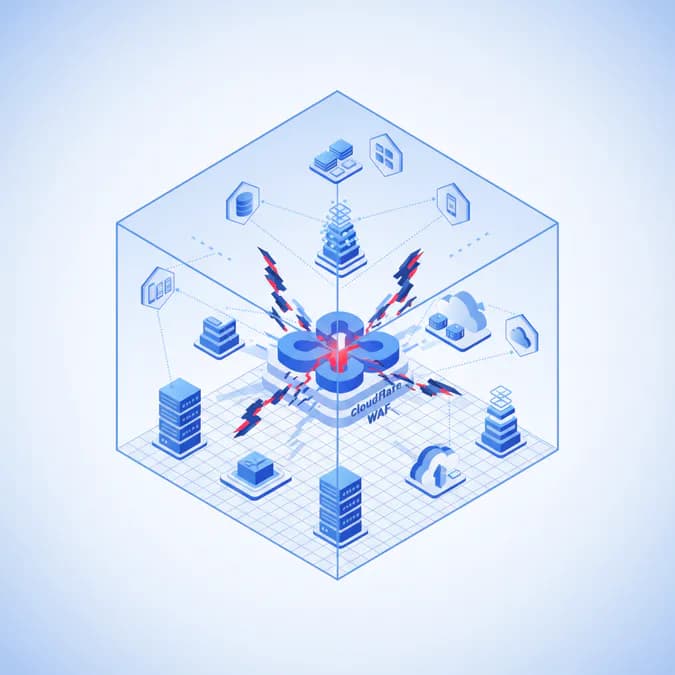
Understanding the Cloudflare WAF Vulnerability
Cloudflare's Web Application Firewall (WAF) is one of the most widely deployed security solutions protecting websites from malicious traffic. The platform serves millions of websites globally, making it a critical component of internet infrastructure. However, in October 2025, security researchers discovered a si

The vulnerability was not in the WAF itself, but rather in how Cloudflare implemented the ACME (Automatic Certificate Management Environment) protocol. ACME is a standardized communications protocol defined in RFC 8555 that automates the issuance, renewal, and revocation of SSL/TLS certificates. Certificate authorities use ACME challenges to verify domain ownership before provisioning certificates. This is a critical security mechanism that ensures only legitimate domain owners can obtain certificates for their domains.
Cloudflare's implementation included a feature that disabled WAF protections during ACME HTTP-01 validation challenges. This made sense in theory—ACME validation requires direct communication with certificate authority servers, and WAF rules might interfere with this legitimate process. However, the implementation contained a fatal flaw that transformed this reasonable design decision into a massive security vulnerability.
How the ACME Validation Flaw Worked
The vulnerability stemmed from improper token validation logic in Cloudflare's ACME HTTP-01 implementation. According to Cloudflare's official statement, "Previously, when Cloudflare was serving an HTTP-01 challenge token, if the path requested by the caller matched a token for an active challenge in our system, the logic serving an ACME challenge token would disable WAF features, since Cloudflare would be directly serving the response."
This description reveals the core problem: Cloudflare's system checked whether a requested path matched a token for an active challenge, but it failed to properly verify whether the incoming token actually belonged to the specific hostname being requested. This meant an attacker could craft requests that appeared to match legitimate ACME challenges without actually being authorized for those specific domains.
The exploitation process worked like this:
- An attacker identifies ACME challenge paths on Cloudflare-protected websites.
- The attacker sends requests to these paths with tokens that matched active challenges in the system (but not necessarily for their target domain).
- Cloudflare incorrectly disables WAF protections based on the path match alone.
- The attacker's request passes directly through to the origin server without any security filtering.
Kirill Firsov, Founder and CEO of FearsOff, explained the severity: "The vulnerability could be exploited by a malicious user to obtain a deterministic, long‑lived token and access sensitive files on the origin server across all Cloudflare hosts, opening the door to reconnaissance." This meant attackers could systematically probe Cloudflare-protected websites for vulnerabilities, access sensitive configuration files, or gather intelligence about backend infrastructure.
One security researcher analyzing the vulnerability described it bluntly: "This is a wildcard bypass on the origin itself. Cloudflare is not blocking or using anything at all. It's just passing this request directly to the origin server." This characterization underscores how completely the vulnerability bypassed Cloudflare's security infrastructure.
The Technical Mechanism
The ACME HTTP-01 challenge is a legitimate mechanism where certificate authorities verify domain ownership by requesting a specific token from a web server. When Cloudflare received such a request, it would temporarily disable WAF protections to allow the challenge response to pass through unfiltered. The vulnerability occurred because the system only verified that the requested path matched a known challenge token, without verifying that the token was actually issued for that specific domain.
This created a situation where an attacker could use any valid token from any active challenge in the Cloudflare system to bypass WAF protections on any domain. Since ACME challenges are public information (they must be accessible to certificate authorities), attackers could easily discover valid tokens and exploit them across multiple targets.
The Real-World Impact on Cloudflare Users
The implications of this vulnerability were staggering. Cloudflare protects millions of websites globally, ranging from small businesses to Fortune 500 companies. The vulnerability affected all of these sites simultaneously, creating a massive attack surface.
The flaw enabled several categories of attacks:
- Reconnaissance: Attackers could probe origin servers to identify running software, version numbers, and configuration details without triggering any WAF alerts.
- Sensitive File Access: Attackers could attempt to access configuration files, backup databases, or private keys on origin servers.
- Vulnerability Exploitation: The vulnerability could serve as a stepping stone for more sophisticated attacks, such as exploiting known vulnerabilities in backend applications that would normally be protected by WAF rules.
- Data Theft: Attackers could potentially access sensitive data stored on origin servers without triggering security alerts.
The deterministic nature of the tokens made the vulnerability particularly dangerous. Unlike random tokens that change with each request, these long-lived tokens remained valid across multiple requests and potentially across different domains. This meant an attacker who obtained one token could use it repeatedly to bypass protections, and the token would remain valid until the underlying ACME challenge expired.
The vulnerability also created a timing window of exposure. While Cloudflare patched the issue on October 27, 2025, the vulnerability had existed since the ACME implementation was deployed. During this period, any sophisticated attacker could have exploited the flaw to compromise Cloudflare-protected websites. The fact that the vulnerability was discovered by white-hat researchers through the bug bounty program raises the question of whether malicious actors had already discovered and exploited it.
Discovery and Reporting by FearsOff
FearsOff, a security research organization, discovered the vulnerability in October 2025 and responsibly reported it through Cloudflare's bug bounty program. This responsible disclosure process is critical for protecting users—it gives vendors time to develop and deploy patches before vulnerability details become public.
FearsOff's discovery demonstrates the importance of independent security research and bug bounty programs. By incentivizing security researchers to find and report vulnerabilities before they can be exploited at scale, companies like Cloudflare can address critical issues before they cause widespread damage.
The research team's analysis revealed not just the existence of the vulnerability, but also its potential impact and exploitation methods. This detailed analysis helped Cloudflare understand the scope of the problem and develop an appropriate fix. According to The Hacker News, the vulnerability was initially reported in October 2025, giving Cloudflare several weeks to develop and test the patch before deployment.
The Bug Bounty Process
Cloudflare's bug bounty program, managed through platforms like HackerOne, provides financial incentives for security researchers to discover and report vulnerabilities responsibly. This program has proven effective in identifying critical issues before they can be exploited in the wild. The FearsOff team's discovery and reporting through this program exemplifies how security research and vendor collaboration can protect millions of users.
Cloudflare's Response and Patch Details
Cloudflare responded to the vulnerability with a patch deployed on October 27, 2025. The fix addressed the root cause: improper token validation. According to Cloudflare's security team, the patch implemented proper validation to ensure that WAF features are only disabled for legitimate ACME challenge requests that actually belong to the requesting domain.
The specific change involved modifying the ACME validation logic to verify not just that a path matched a token, but that the token was actually associated with the specific hostname being requested. This seemingly simple change eliminated the vulnerability by ensuring that attackers could not use tokens from one domain to bypass protections on another domain.
Related Security Updates
Following the initial ACME validation fix, Cloudflare's WAF team implemented additional protections. In January 2026, Cloudflare addressed a related vulnerability involving header overflow attacks that could be used to circumvent WAF rules and poison caches. The team deployed global rules to block requests with excessive headers, demonstrating a commitment to addressing not just the immediate vulnerability but also related attack vectors.
This proactive approach to security demonstrates that Cloudflare is taking the incident seriously and implementing comprehensive fixes rather than just patching the specific reported vulnerability.
Key Lessons for Web Security
The Cloudflare WAF vulnerability illustrates several critical lessons for web security professionals and organizations.
Security Features Require Rigorous Integration
Cloudflare's decision to disable WAF protections during ACME validation was reasonable, but the implementation was flawed. This demonstrates that even well-intentioned security design decisions require rigorous validation and testing. When security features interact with each other, the interaction points become critical security boundaries that deserve special attention.
Certificate Management Protocols Deserve Special Attention
ACME is a critical protocol that interacts with security infrastructure at a fundamental level. Any implementation of ACME should receive thorough security review, including consideration of how it interacts with other security systems. The protocol's role in certificate provisioning makes it a high-value target for attackers, and any flaws in its implementation can have widespread consequences.
Token Validation is Harder Than It Appears
The vulnerability stemmed from incomplete token validation—checking that a token matched an active challenge without verifying it belonged to the specific domain. This is a subtle but critical distinction that could easily be missed in code review. Security teams should implement comprehensive validation logic that checks all relevant attributes of tokens, not just their existence.
Responsible Disclosure Works
FearsOff's discovery and responsible reporting allowed Cloudflare to patch the vulnerability before it could be exploited at scale. Organizations should maintain active bug bounty programs and respond quickly to reported vulnerabilities. The security research community benefits when vendors take responsible disclosure seriously.
Security is an Ongoing Process
Even after the initial patch, Cloudflare discovered and addressed related vulnerabilities like the header overflow issue. Continuous monitoring and improvement are essential. Security teams should regularly review their implementations for similar flaws and proactively address potential weaknesses.
Recommendations for Organizations
For organizations using Cloudflare, the key recommendations are:
- Ensure you have updated to the patched version released on October 27, 2025.
- Review your WAF rules and security configuration to ensure they are properly configured.
- Implement defense-in-depth principles by adding additional security measures at the application and infrastructure levels.
- Monitor your origin servers for any suspicious activity that might indicate exploitation attempts.
- Consider implementing additional logging and monitoring to detect attempts to exploit ACME paths.
- Review your certificate management processes to ensure they are secure.
The Cloudflare WAF vulnerability represents a significant security incident, but it also demonstrates how responsible disclosure, security research, and rapid patching can minimize real-world impact. By understanding how this vulnerability worked and what it reveals about web security, organizations can better protect their own infrastructure and make more informed decisions about their security architecture. The incident underscores the importance of thorough security testing, responsible disclosure practices, and the critical role that independent security researchers play in protecting the internet.
Key Takeaways
- Understand the Cloudflare WAF vulnerability and its implications for web security.
- Implement robust token validation processes to prevent unauthorized access.
- Engage in responsible disclosure practices to enhance overall security.
- Continuously monitor and improve security measures to address emerging threats.
Frequently Asked Questions
What is the Cloudflare WAF vulnerability?
The Cloudflare WAF vulnerability refers to a flaw in the implementation of the ACME protocol that allowed attackers to bypass WAF protections and access sensitive data on origin servers.
How was the vulnerability discovered?
The vulnerability was discovered by FearsOff, a security research organization, which reported it through Cloudflare's bug bounty program.
What measures did Cloudflare take to address the vulnerability?
Cloudflare deployed a patch on October 27, 2025, that implemented proper token validation to ensure WAF protections were only disabled for legitimate ACME challenge requests.
What lessons can organizations learn from this incident?
Organizations can learn the importance of rigorous security testing, responsible disclosure, and continuous monitoring to protect against vulnerabilities.