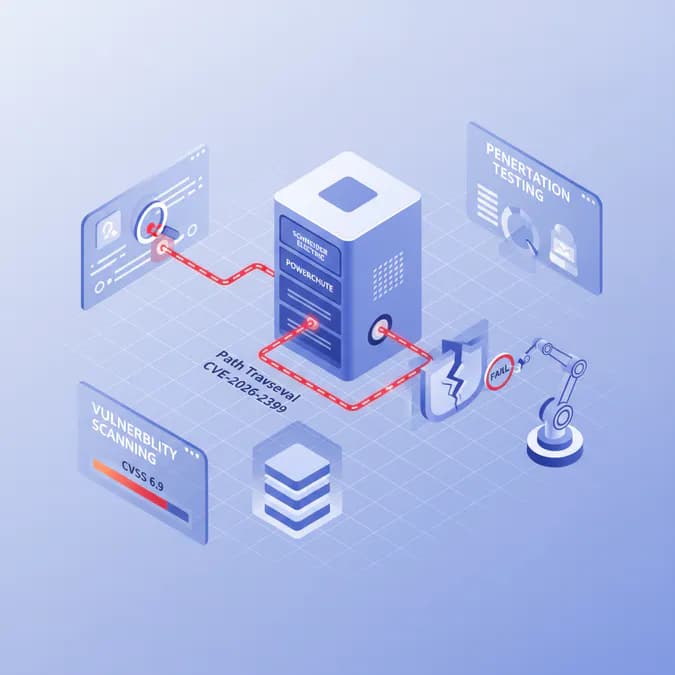
Path traversal vulnerabilities represent a critical security threat, and CVE-2026-2399 exemplifies this risk in the Web Admin interface of Schneider Electric's PowerChute Serial Shutdown software. This comprehensive guide provides technical details, affected versions, severity assessment, and proven mitigation strategies. Organizations using affected Web Admin versions should implement immediate patching to prevent potential exploitation and unauthorized access to restricted files and directories.
Vulnerability Overview
CVE-2026-2399 is a path traversal vulnerability discovered in the Web Admin interface of Schneider Electric's PowerChute Serial Shutdown software. Directory traversal vulnerabilities, also known as path traversal attacks, enable attackers to access files and directories outside of the intended web server root directory. This can result

The vulnerability is classified as CWE-22: Improper Limitation of a Pathname to a Restricted Directory. This classification indicates that the application fails to properly validate user-supplied input that specifies a file path, allowing attackers to manipulate paths and access unauthorized resources. Industry experts note that path traversal attacks using sequences like ../ represent a fundamental input validation weakness that can compromise system integrity and confidentiality. Research indicates that such vulnerabilities remain prevalent in web applications due to inadequate path canonicalization and validation mechanisms.
Technical Details and Attack Vector
The specific vulnerability, CVE-2026-2399, affects the Web Admin interface of Schneider Electric's PowerChute Serial Shutdown software. It is located in the POST /REST/upssleep endpoint. An authenticated Web Admin user can alter the request payload, using directory traversal techniques such as ../ (dot-dot-slash) sequences, to navigate the file system and overwrite critical files with arbitrary text data.
This attack vector exploits insufficient input validation and sanitization within the Web Admin interface. By manipulating the file path, an attacker can bypass intended access restrictions and gain unauthorized access to sensitive files and directories. The path traversal attack pattern, documented as CAPEC-126, describes this type of exploitation in detail. When attackers successfully execute a path traversal attack, they can traverse directory structures using relative path components, potentially accessing configuration files, system binaries, or other sensitive resources outside the application's intended scope.
Affected Versions and Products
The vulnerability affects specific versions of Schneider Electric's PowerChute Serial Shutdown software that utilize the vulnerable Web Admin interface. While specific version numbers are not provided in the original disclosure, it is crucial to consult the official Schneider Electric security advisory SEVD-2026-104-01 for a comprehensive list of affected versions. Users of PowerChute Serial Shutdown should verify their software version against the advisory and apply the recommended patches or updates immediately to eliminate path traversal risks.
Severity Assessment and CVSS Score
CVE-2026-2399 has been assigned a CVSS score of 6.9 (MEDIUM). This score reflects the potential impact of the vulnerability, considering factors such as the ease of exploitation, the level of access required, and the potential damage from a successful attack. Although classified as medium severity, the ability to overwrite critical files can lead to significant disruption of UPS management and server shutdown processes, especially in enterprise environments managing power infrastructure.
The CVSS score is calculated based on several metrics, including attack vector, attack complexity, privileges required, user interaction, scope, confidentiality impact, integrity impact, and availability impact. A score of 6.9 indicates that the vulnerability is exploitable with relative ease, requires authentication, and can lead to partial compromise of system integrity and availability. Organizations should treat this path traversal vulnerability with appropriate urgency given its potential operational impact on critical infrastructure and business continuity.
Impact Analysis
The impact of CVE-2026-2399 can be significant, particularly in environments where PowerChute Serial Shutdown is used to manage critical power infrastructure. Successful exploitation of the vulnerability could allow an attacker to:
- Disrupt UPS Management: By overwriting critical configuration files, an attacker could disrupt the normal operation of the UPS system, potentially leading to unexpected shutdowns or power outages in data centers or enterprise facilities.
- Compromise Server Shutdown Processes: The vulnerability could be used to manipulate server shutdown processes, causing data loss or system instability that affects business operations.
- Gain Unauthorized Access: In some cases, successful exploitation of a path traversal vulnerability can lead to further exploitation, such as remote code execution or privilege escalation that compromises the entire system.
- Modify Critical Files: Attackers can alter configuration files, scripts, or other sensitive data to maintain persistence or cause operational disruption across the infrastructure.
Given these potential impacts, organizations using affected versions of PowerChute Serial Shutdown should prioritize patching and implementing the recommended mitigation measures to prevent path traversal exploitation.
Path Traversal Mitigation and Remediation Steps
The primary mitigation strategy for CVE-2026-2399 is to apply the patch or upgrade to the latest version of PowerChute Serial Shutdown as provided by Schneider Electric in their security advisory SEVD-2026-104-01. In addition to patching, organizations should consider implementing the following security best practices to prevent path traversal attacks:
- Input Validation: Implement robust input validation and sanitization techniques to prevent path traversal attacks. This includes validating file paths, restricting user input to a whitelist of allowed characters, and canonicalizing file paths to remove any potentially malicious sequences like
../or encoded variants such as..%2For..%5C. - Principle of Least Privilege: Ensure that the Web Admin interface and the PowerChute Serial Shutdown software are running with the minimum necessary privileges. This can help to limit the impact of a successful attack and reduce the scope of accessible resources.
- Web Application Firewall (WAF): Deploy a Web Application Firewall (WAF) to detect and block path traversal attacks. A WAF can analyze HTTP requests and responses for malicious patterns and block suspicious traffic attempting directory traversal or file system manipulation.
- Regular Security Audits: Conduct regular security audits and penetration testing to identify and address potential vulnerabilities in the Web Admin interface and other critical systems. This proactive approach helps discover weaknesses before attackers can exploit them.
- Path Canonicalization: Implement proper path canonicalization to resolve symbolic links and relative path references before validating file access permissions. This ensures that all path variations are normalized to their absolute forms.
Detection Methods
Several methods can be used to detect potential exploitation attempts of CVE-2026-2399 and other path traversal vulnerabilities:
- Intrusion Detection Systems (IDS): Configure an Intrusion Detection System (IDS) to monitor network traffic for suspicious patterns, such as attempts to access restricted files or directories using path traversal sequences. IDS solutions can identify encoded variants and obfuscated traversal attempts.
- Log Analysis: Analyze web server logs for unusual activity, such as requests containing
../sequences, encoded traversal attempts like%2e%2e%2f, or attempts to access files outside of the intended web server root directory. Automated log analysis tools can correlate suspicious patterns. - File Integrity Monitoring (FIM): Implement File Integrity Monitoring (FIM) to detect unauthorized changes to critical system files. This can help to identify if an attacker has successfully exploited the vulnerability to overwrite configuration files or other sensitive data.
- Behavioral Analysis: Monitor for abnormal file access patterns or unexpected modifications to system files that may indicate a successful path traversal attack. Behavioral analytics can establish baselines for normal activity and alert on deviations.
Timeline and Disclosure History
- April 14, 2026: CVE-2026-2399 is published and the Schneider Electric Security Advisory SEVD-2026-104-01 is released, alerting organizations to the path traversal vulnerability.
- Ongoing: Security researchers and organizations, including SentinelOne, continue to analyze the vulnerability and provide remediation guidance to help organizations patch their systems.
Frequently Asked Questions
What is a path traversal vulnerability? A path traversal vulnerability is a security flaw that allows attackers to access files and directories outside the intended scope of a web application. Attackers exploit insufficient input validation to navigate the file system using relative path sequences like ../.
How does CVE-2026-2399 differ from other path traversal vulnerabilities? CVE-2026-2399 specifically targets the Web Admin interface of PowerChute Serial Shutdown and allows authenticated users to overwrite critical files. The vulnerability's impact on UPS management and server shutdown processes makes it particularly dangerous in enterprise environments.
Who is affected by CVE-2026-2399? Organizations using affected versions of Schneider Electric's PowerChute Serial Shutdown software are at risk. The vulnerability requires authentication, so it primarily affects users with legitimate access to the Web Admin interface who may be compromised or acting maliciously.
What should I do if I'm running an affected version? Apply the patch or upgrade to the latest version of PowerChute Serial Shutdown as recommended in Schneider Electric's security advisory SEVD-2026-104-01. Additionally, implement the security best practices outlined in this guide to prevent path traversal exploitation.
Can a Web Application Firewall prevent path traversal attacks? Yes, a properly configured WAF can detect and block many path traversal attacks by analyzing request patterns and blocking suspicious sequences. However, WAF should be used as a complementary control alongside proper input validation and patching.
Key Takeaways
- CVE-2026-2399 is a path traversal vulnerability affecting the Web Admin interface of Schneider Electric's PowerChute Serial Shutdown software.
- The vulnerability allows authenticated users to overwrite critical files using directory traversal techniques and
../sequences, potentially disrupting critical infrastructure. - The CVSS score is 6.9 (MEDIUM), indicating a moderate level of risk with significant operational impact potential in enterprise environments.
- Organizations using affected versions should apply the patch or upgrade to the latest version as soon as possible to eliminate path traversal risks.
- Implementing security best practices, such as input validation, WAF deployment, and path canonicalization, can help to mitigate the risk of path traversal exploitation.
- Regular monitoring through IDS, log analysis, and file integrity monitoring can detect exploitation attempts and unauthorized file modifications.
- A defense-in-depth approach combining patching, input validation, access controls, and monitoring provides the strongest protection against path traversal attacks.
By understanding the technical details, potential impact, and mitigation strategies for CVE-2026-2399, organizations can take proactive steps to protect their systems and prevent potential exploitation of this path traversal vulnerability. Prioritizing security updates and implementing comprehensive controls will significantly reduce the risk of unauthorized file access and system compromise in critical infrastructure environments.
Sources
- Automated Pipeline
- CVE-2026-2399 Security Vulnerability Analysis & Exploit Details
- CVE-2026-2399 | Mondoo Vulnerability Intelligence
- CVE-2026-2399 Detail - NVD
- CVE-2026-2399 - Exploits & Severity - Feedly
- Schneider Electric Security Advisory SEVD-2026-104-01
- Source: sentinelone.com
- Source: opencve.ameos.net
- Source: github.com
- Source: proteuscyber.com
- Source: recordedfuture.com