The cybersecurity landscape is constantly evolving, and the latest Cloudflare 2026 threat report paints a stark picture of the challenges organizations face. Published on March 3, 2026, the report details a fundamental shift toward industrialized cyber threats, marked by a record-breaking 31.4 Tbps DDoS attack and increasingly sophisticated attack methodologies. This article delves into the key findings of the report, exploring the trends, statistics, and implications for organizations seeking to bolster their defenses.
Introduction to 2026 Threat Landscape
The Cloudflare 2026 threat report, released on March 3, 2026, provides a comprehensive analysis of the evolving cybersecurity threat landscape. Based on data from Cloudflare's global network, which handles approximately 20% of

Industrialization of Cyber Threats
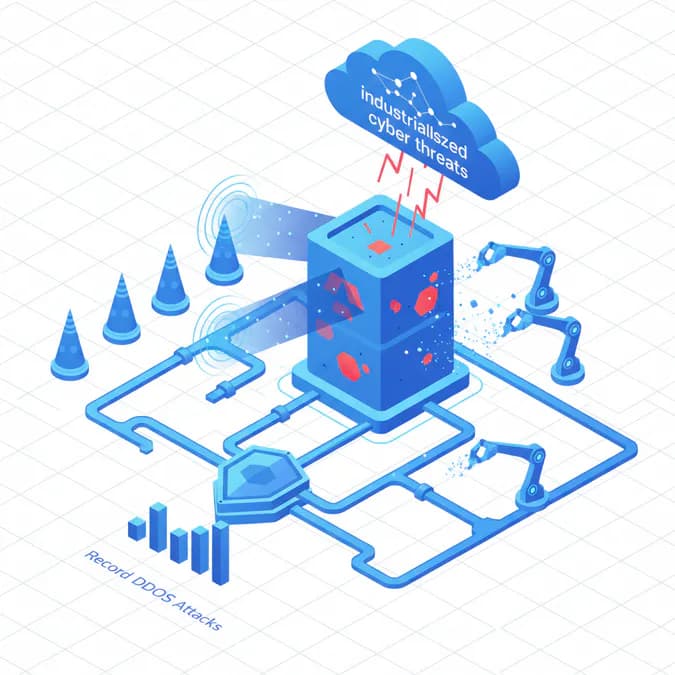
One of the most significant findings of the Cloudflare 2026 threat report is the increasing industrialization of cybercrime. This trend is driven by the weaponization of artificial intelligence, which enables attackers to automate and scale their operations with unprecedented efficiency. According to the report, AI is being used for:
- Real-time network mapping and reconnaissance
- Exploit development and deployment
- Deepfake creation for social engineering
- Automated attack operations at scale
This industrialization allows threat actors to move faster and more efficiently, reducing the time between initial access and data theft. As Brian Carter and Chris Peacey, Cloudflare Threat Intelligence Experts, noted, "Cybercrime is becoming increasingly industrialized. Attackers are scaling operations and adopting new techniques, from hyper-volumetric DDoS attacks to identity weaponization, with AI accelerating the time between initial access and data theft." This shift underscores how modern threat actors operate like organized enterprises rather than individual hackers, leveraging automation to maximize impact across multiple targets simultaneously.
Record DDoS Attack Analysis
The report documents a record-breaking 31.4 Tbps DDoS attack launched by the Aisuru botnet in November 2025. This attack was nearly six times larger than the previous year's peak, demonstrating the increasing scale and sophistication of DDoS attacks. The report also reveals that the total number of DDoS attacks more than doubled in 2025, reaching 47.1 million incidents, with network-layer attacks tripling year-over-year. This surge in DDoS attacks highlights the need for robust DDoS mitigation strategies, as emphasized in the Gartner Magic Quadrant for DDoS Mitigation Services 2026 and the Forrester Wave: DDoS Mitigation Platforms Q1 2026. Research indicates that organizations without dedicated DDoS protection face significant operational and financial risks when facing such hyper-volumetric attacks.
Sophisticated Attack Methodologies
Beyond DDoS attacks, the Cloudflare 2026 threat report highlights several other sophisticated attack methodologies that organizations must defend against. These include:
- Credential-based attacks: The report found that 94% of login attempts originate from bots, and 63% of logins involve credentials already compromised elsewhere. This underscores the prevalence of credential stuffing and password reuse attacks, making identity verification critical for modern security strategies.
- Exploitation of trusted infrastructure: Threat actors are increasingly exploiting over-privileged SaaS integrations and legitimate cloud services (e.g., Google Calendar, Dropbox, GitHub, AWS, Azure) to mask malicious activity and evade detection systems.
- AI-generated deepfakes: North Korean operatives are using AI-generated deepfakes and fraudulent credentials to embed state-sponsored workers into Western corporate payrolls via laptop farms, representing a novel form of insider threat.
- Pre-positioning in critical infrastructure: State-sponsored threat actors, such as Chinese groups Salt Typhoon and Linen Typhoon, are conducting pre-positioning operations in North American telecommunications infrastructure, establishing persistent access for future exploitation.
Key Findings from Threat Report
To summarize, the Cloudflare 2026 threat report reveals several key findings that organizations need to be aware of:
- Cybercrime is becoming increasingly industrialized, with AI playing a key role in automating and scaling attacks across multiple vectors and targets.
- DDoS attacks are growing in size and frequency, with a record-breaking 31.4 Tbps attack recorded in November 2025, demonstrating the need for advanced mitigation.
- Credential-based attacks remain a significant threat, with the majority of login attempts originating from bots and involving compromised credentials from previous breaches.
- Threat actors are exploiting trusted infrastructure and legitimate cloud services to mask malicious activity and bypass traditional security controls.
- State-sponsored actors are conducting pre-positioning operations in critical infrastructure, establishing persistent footholds for future attacks.
Implications for Organizations
The findings of the Cloudflare 2026 threat report have significant implications for organizations of all sizes. The increasing sophistication and industrialization of cyber threats mean that traditional security measures are no longer sufficient. Organizations need to adopt a more proactive and adaptive approach to cybersecurity, focusing on:
- Identity-centric security: Verifying the identity of users and devices is crucial in preventing credential-based attacks and unauthorized access. As the Cloudflare Threat Intelligence Team stated, "Security is no longer about keeping strangers out, it's about proving that the users inside your network are who they say they are." This philosophy represents a fundamental shift from perimeter-based defense to zero-trust principles.
- Automated threat detection and response: The sheer volume and speed of modern cyber attacks require automated threat detection and response capabilities that can operate at machine speed, identifying and neutralizing threats before human intervention becomes necessary.
- Robust DDoS mitigation: Organizations need to implement robust DDoS mitigation strategies to protect their networks and applications from hyper-volumetric attacks that can overwhelm traditional infrastructure.
- Third-party risk management: Organizations need to carefully assess and manage the risks associated with third-party SaaS integrations and cloud services, ensuring that legitimate tools cannot be weaponized by threat actors.
- Employee training and awareness: Employees need to be trained to recognize and avoid phishing attacks, deepfakes, and other social engineering tactics that exploit human psychology and trust.
Recommendations and Mitigation Strategies
Based on the findings of the Cloudflare 2026 threat report, organizations should consider implementing the following mitigation strategies to strengthen their security posture:
- Implement multi-factor authentication (MFA) for all users and devices to prevent unauthorized access even when credentials are compromised.
- Use strong and unique passwords for all accounts, enforcing password complexity requirements and regular rotation policies.
- Regularly monitor and audit user access privileges to ensure the principle of least privilege is maintained across your organization.
- Implement a zero-trust security model that verifies every access request, regardless of source or location, to eliminate implicit trust.
- Use a web application firewall (WAF) to protect against web-based attacks and filter malicious traffic before it reaches your applications.
- Implement a DDoS mitigation solution capable of handling hyper-volumetric attacks and protecting critical infrastructure from disruption.
- Regularly scan for vulnerabilities and patch systems promptly to eliminate known attack vectors and reduce exposure windows.
- Implement a security information and event management (SIEM) system to aggregate and analyze security events across your entire infrastructure.
- Conduct regular security awareness training for employees to build a human firewall against social engineering and phishing attacks.
The Bottom Line
The Cloudflare 2026 threat report provides valuable insights into the evolving cybersecurity threat landscape. The report highlights the increasing industrialization of cybercrime, the growing sophistication of attack methodologies, and the need for organizations to adopt a more proactive and adaptive approach to security. By implementing the recommendations and mitigation strategies outlined in this article, organizations can better protect themselves from the ever-growing threat of cyber attacks. The shift toward industrialized, AI-driven threats demands that security strategies evolve beyond traditional defenses to embrace automation, identity verification, and continuous monitoring. Organizations that act now to implement these proven defense mechanisms will be better positioned to withstand the sophisticated threats documented in this comprehensive threat report.
Sources
- Automated Pipeline
- Cloudforce One Threat Intelligence: 2026 Annual Report
- Gartner Magic Quadrant for DDoS Mitigation Services 2026
- Forrester Wave: DDoS Mitigation Platforms Q1 2026
- Source: blog.cloudflare.com
- Source: cloudflare.com
- Source: helpnetsecurity.com
- Source: thisweekinnet.substack.com
- Source: youtube.com
- Source: varindia.com
- Source: cloudflare.tv
- Source: ppc.land