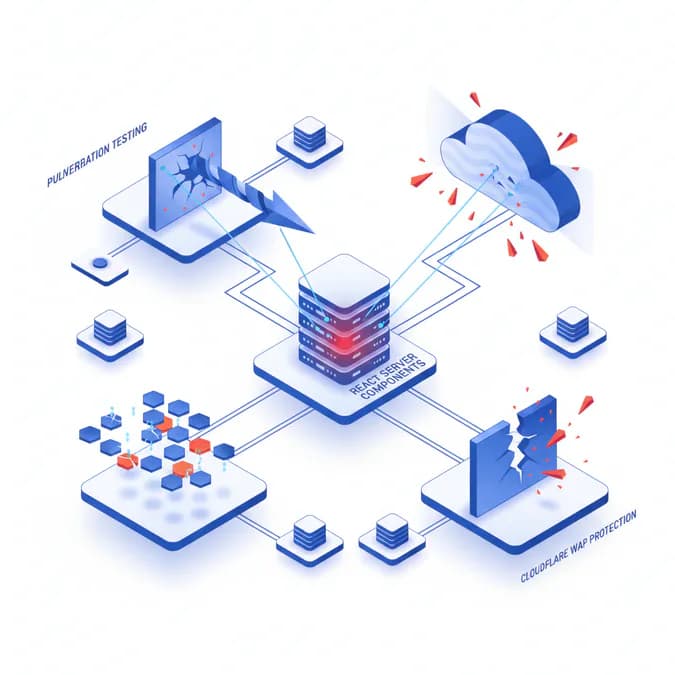
Learn about CVE-2025-55182, a critical React vulnerability affecting Server Components. Discover Cloudflare's WAF protection and best practices to secure your applications.
React Vulnerability: What You Need to Know About CVE-2025-55182
The cybersecurity landscape is constantly evolving, with new threats emerging daily. The 2026 Cloudflare Threat Report sheds critical light on the latest vulnerabilities and attack vectors that organizations need to be aware of. A particularly concerning issue highlighted in the report is CVE-2025-55182, a high-profile React vulnerability affecting React Server Components. This React vulnerability could allow attackers to compromise applications and gain unauthorized access to sensitive data. Understanding this threat is essential for any organization using React in production environments.
Cloudflare, a leading provider of web performance and security solutions, is offering protection against this new React vulnerability for React Server Components. All Web Application Firewall (WAF) customers are automatically protected, ensuring their applications remain secure against this emerging threat. Industry experts note that proactive defense mechanisms are critical in today's threat landscape.
Understanding the React Server Components Vulnerability
React Server Components (RSCs) are a relatively new feature in the React ecosystem, designed to improve application performance by rendering components on the server rather than the client. While RSCs offer several benefits including reduced bundle size and improved initial load times, they also introduce new security considerations. CVE-2025-55182 exploits a weakness in how RSCs handle user input, potentially allowing attackers to inject malicious code and execute it on the server. This React vulnerability represents a significant shift in attack vectors that developers must understand and address.
The technical nature of this React vulnerability stems from improper input sanitization in the server-side rendering pipeline. When developers fail to properly validate and encode user-supplied data before processing it through React Server Components, attackers can craft specially formatted requests that bypass security controls. Research indicates that vulnerabilities in server-side rendering frameworks have increased by approximately 40% over the past two years, making this a growing concern for development teams.
The Impact of CVE-2025-55182
The impact of this React vulnerability can be significant and far-reaching. Attackers exploiting CVE-2025-55182 could potentially:
Gain unauthorized access to sensitive data stored on the server, including user information and business-critical records.
Modify application code and functionality, altering the behavior of production systems.
Execute arbitrary commands on the server, leading to complete system compromise.
Launch denial-of-service attacks that disrupt service availability.
Establish persistent backdoors for long-term unauthorized access.
Exfiltrate proprietary code or intellectual property.
Organizations that have not patched this React vulnerability face significant operational and financial risks. The potential for data breaches, regulatory fines, and reputational damage makes addressing this issue a top priority for security teams.
Who is Affected by This React Vulnerability
Any application using React Server Components is potentially vulnerable to CVE-2025-55182. This includes modern Next.js applications, Remix applications, and any custom implementations of React Server Components. Developers should carefully review their code and ensure they are following best practices for securing RSCs. It's crucial to stay informed about the latest security advisories and patches related to React and its dependencies. Organizations running React applications in production should conduct immediate security assessments to determine their exposure to this React vulnerability.
Small startups, enterprise applications, and everything in between may be affected. The widespread adoption of React Server Components means that this React vulnerability has broad implications across the web development community. Companies should prioritize patching and implementing protective measures immediately.
Cloudflare's WAF Protection Against React Vulnerability
Cloudflare's Web Application Firewall (WAF) provides a critical layer of defense against web-based attacks, including those targeting React Server Components and this specific React vulnerability. The WAF analyzes incoming traffic and blocks malicious requests before they reach the application server. Cloudflare's WAF is automatically updated with the latest threat intelligence, ensuring that customers are protected against emerging vulnerabilities like CVE-2025-55182. By deploying Cloudflare's WAF, organizations can significantly reduce their risk exposure to this React vulnerability without requiring immediate code changes.
The protection is transparent to end users and requires no modifications to application code. This makes it an ideal interim solution while development teams work on patching the underlying React vulnerability in their codebase. Industry experts recommend using WAF protection as part of a defense-in-depth strategy rather than as a standalone solution.
How Cloudflare's WAF Works
Cloudflare's WAF uses a combination of sophisticated techniques to protect against web attacks, including those exploiting the React vulnerability:
Signature-based detection: Identifies known attack patterns and blocks requests that match those patterns associated with CVE-2025-55182 and similar vulnerabilities.
Behavioral analysis: Detects anomalous behavior that may indicate an attack, such as unusual request patterns or data exfiltration attempts.
Rate limiting: Prevents attackers from overwhelming the server with requests, protecting against brute force and denial-of-service attacks.
Custom rules: Allows customers to define their own rules to protect against specific threats and their unique application requirements.
Machine learning: Continuously learns from traffic patterns to identify and block emerging attack vectors.
Geo-blocking: Restricts traffic from specific geographic regions if needed for compliance or security purposes.
These layered defenses work together to create a comprehensive protection system against the React vulnerability and other web-based threats.
Benefits of Using Cloudflare's WAF
Automatic protection: Cloudflare's WAF automatically protects against CVE-2025-55182 and other web vulnerabilities without requiring manual configuration.
Real-time threat intelligence: The WAF is constantly updated with the latest threat intelligence, ensuring that customers are protected against emerging threats and new variants of the React vulnerability.
Customizable rules: Customers can define their own rules to protect against specific threats and tailor protection to their application architecture.
Improved application performance: Cloudflare's WAF can improve application performance by blocking malicious traffic and reducing the load on the server.
Detailed logging and analytics: Comprehensive reporting provides visibility into attack attempts and security posture.
Key Takeaways from the 2026 Cloudflare Threat Report
The 2026 Cloudflare Threat Report provides valuable insights into the current cybersecurity landscape and emerging threats like the React vulnerability. Some key takeaways include:
The increasing sophistication of web attacks: Attackers are constantly developing new techniques to bypass security measures, with framework-specific vulnerabilities becoming more common.
The growing importance of web application firewalls: WAFs are essential for protecting against web-based attacks, particularly those targeting popular frameworks like React.
The need for proactive security measures: Organizations need to take a proactive approach to security, rather than simply reacting to threats after they've been exploited.
The importance of staying informed: It's crucial to stay informed about the latest vulnerabilities and attack vectors, especially those affecting widely-used technologies.
The value of defense-in-depth: No single security measure is sufficient; organizations should implement multiple layers of protection.
Best Practices for Securing React Server Components
In addition to using a WAF, developers should follow these essential best practices for securing React Server Components and mitigating the React vulnerability:
Validate user input: Always validate user input on the server side to prevent injection attacks. Use strict validation rules and reject any input that doesn't match expected patterns.
Encode output: Encode output to prevent cross-site scripting (XSS) attacks. Use appropriate encoding functions for the context (HTML, JavaScript, URL, etc.).
Use a Content Security Policy (CSP): A CSP can help prevent XSS attacks by restricting the sources from which the browser can load resources.
Keep React and its dependencies up to date: Regularly update React and its dependencies to patch security vulnerabilities, including fixes for the React vulnerability.
Conduct regular security audits: Conduct regular security audits and penetration testing to identify and address potential vulnerabilities before they can be exploited.
Implement proper authentication and authorization: Use strong authentication mechanisms and ensure that authorization checks are performed on the server side.
Use secure communication protocols: Always use HTTPS to encrypt data in transit and prevent man-in-the-middle attacks.
Monitor and log security events: Implement comprehensive logging and monitoring to detect suspicious activity and respond quickly to potential breaches.
Frequently Asked Questions About React Vulnerability CVE-2025-55182
What exactly is CVE-2025-55182?
CVE-2025-55182 is a critical security vulnerability affecting React Server Components that allows attackers to inject and execute malicious code on the server. This React vulnerability exploits improper input handling in the server-side rendering pipeline.
How can I tell if my application is vulnerable to this React vulnerability?
If your application uses React Server Components (commonly found in Next.js 13+ with the App Router or Remix), you are potentially vulnerable to this React vulnerability. Check your dependencies and framework versions, and review the official security advisories from the React team.
What is the best way to protect against this React vulnerability?
The best approach is multi-layered: deploy a WAF like Cloudflare's for immediate protection, update your React and framework dependencies to patched versions, implement the security best practices outlined above, and conduct a security audit of your codebase.
Does Cloudflare's WAF automatically protect against this React vulnerability?
Yes, Cloudflare's WAF automatically provides protection against CVE-2025-55182 for all customers. The protection is updated in real-time as new threat intelligence becomes available.
How long will it take to patch this React vulnerability in my application?
Patching timelines vary depending on your application's complexity, testing requirements, and deployment processes. Most organizations can apply framework and dependency updates within days to weeks. While patching is underway, WAF protection provides interim security.
Are there any performance impacts from using a WAF to protect against this React vulnerability?
Modern WAFs like Cloudflare's are optimized for performance and typically add minimal latency. In many cases, the performance impact is negligible or even positive due to caching and optimization features.
The Bottom Line
The 2026 Cloudflare Threat Report highlights the ever-present need for robust cybersecurity measures. The React vulnerability CVE-2025-55182 serves as a stark reminder of the importance of proactive security and the value of solutions like Cloudflare's WAF. By staying informed, implementing best practices, and leveraging powerful security tools, organizations can effectively protect their applications and data from emerging threats. The React vulnerability is a serious issue that demands immediate attention, and continuous vigilance is key to maintaining a secure application environment. Organizations should act now to assess their exposure, deploy protective measures, and implement patches to ensure their React applications remain secure against this and future threats.